ON 20th July, Keir Starmer stepped down as Britain’s prime minister, having disappointed and betrayed millions of voters. Six years earlier, he had been elected Labour leader on a fraudulent prospectus, posing as a supporter of Jeremy Corbyn but soon revealing himself to be an entrenched right-winger who handed the party over to malicious hacks thirsting for revenge against the left.
Not only did Starmer rapidly trash all the policies and commitments that won him the leadership of the party. He also discarded the coalition of voters that Corbyn’s leadership had assembled, only to end up securing even fewer votes in 2024 than Corbynism had done at its lowest point in 2019.
The most authoritarian Labour leader ever, Starmer’s tenure was characterised by a series of witchhunts. Predictably, the right-wing media, thrilled by the purge of the left, supported him, while Starmer himself eagerly supported the genocide in Gaza, lending the Labour Party’s backing to Israeli moves to cut off water, electricity, food and medicines from the Palestinian people. On economic policy he (and his chancellor Rachel Reeves) stuck close to Treasury and City of London orthodoxy while pandering to Donald Trump on defence.
His successor, Andy Burnham, who has now become the seventh prime minister since the Brexit vote a decade ago, may not inspire a lot of hope amid the soundbites. Nevertheless it should be almost impossible for the new leader to be as bad as his predecessor.
Standing outside 10 Downing Street, Burnham’s pitch to the country struck many of the right notes, attacking the concentration of wealth and power in London and the south-east, and the surrender of public control of basics like water, energy, housing and transport. In other words, his premise – that Britain has been on the wrong track for 40 years, since political power was centralised and economic power was privatised – is basically the same as Corbyn’s. However, unlike Corbyn, who never got to implement Labour’s 2017 manifesto, Burnham seems to believe that the government can deliver the changes it promises without a ruthless break with the City, with the oligarchical press and with a parliamentary Labour Party stuffed with Blairite zombies. His Cabinet reshuffle was also ominous. The early favourite to be Chancellor of the Exchequer, Ed Miliband, lost out to the right-wing former defence secretary, John Healey, whose appointment could be a setback for climate policy.
So far Burnham has been relatively quiet about the climate crisis, which may not be at the forefront of his mind. Rescuing the British economy is top of his prime ministerial to-do list, but the Alliance for Green Socialism has consistently argued that rescuing the climate (and nature) is inseparable from that. Too often in the past, politicians have treated the economy and the climate crisis as if they were unconnected, but it’s much better to solve these twin problems in a holistic and joined-up way.
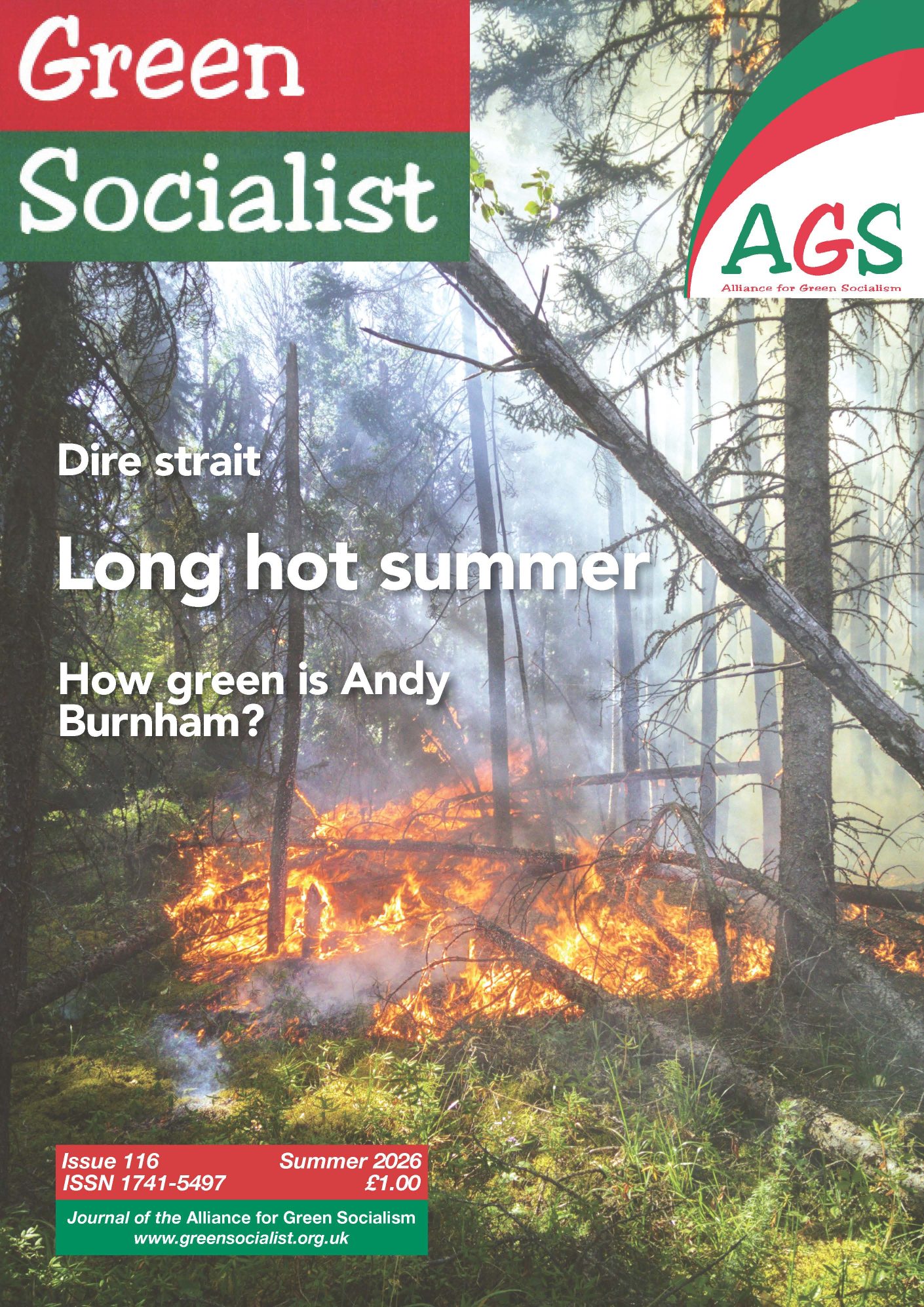
Because, as Yann Westwood explains in the latest issue of Green Socialist 116 (Summer 2026), even if Burnham wishes to ignore the climate crisis, it certainly won’t be ignoring Britain. The heatwaves in May and June and July, which killed about 3,000 people, also hit businesses to the tune of at least £2.5 billion in lost productivity. Another poor harvest will be the fourth since 2020, hurting farmers and hitting consumers with higher shopping bills. If, as forecast, a fossil fuel-driven super El Niño weather system strikes in the southern hemisphere, food prices will soar even further.
Tackling the energy crisis would be good for our economy, as Miliband argued, but so would helping nature and the biosphere to flourish, with immeasurable benefits for the nation’s health and wellbeing – for our national security, in other words.
So how green is Andy Burnham? His record as mayor of Greater Manchester suggests that at least he understands the challenge ahead. He set a local target of reaching net zero carbon emissions by 2038, began to electrify the bus service and embarked on a widespread home insulation programme. But while, as mayor, he rejected fracking for the north-west of England, Burnham as prime minister has already been less clear about the North Sea, saying he is ‘open-minded’ about the prospect of more drilling.
The Tories and Reform UK, along with some sections of Labour, including the former prime minister Tony Blair, blame soaring energy costs on policies to reduce carbon emissions to net zero by 2050. They want to go for growth at all costs, and that includes high-carbon and fossil-fuelled growth. Yet leading economists, including Fatih Birol, the head of the International Energy Agency, have said that reindustrialisation can also be green, and that new fields in the North Sea won’t bring down UK fuel prices anyway. The way to do that is to reform the energy market itself by taking the gas and electricity companies back into public ownership.
One of the key decisions Burnham will face is over the future of the Jackdaw gasfield. Along with the Rosebank oilfield west of Shetland, it could slip through Labour’s manifesto promise to ban new licences, as both are already in the planning process. Speculation is growing that Burnham could green-light Jackdaw as a sop to right-wingers. That would be a huge mistake, and would only result in yet more Starmer-like disappointment and betrayal.
Cover photo by Landon Parenteau/Unsplash

